Last March at SXSW, Matthew Prince told an audience that bot traffic would overtake human traffic by 2027. The Cloudflare CEO had previously said end of 2027, then early 2027, then in March he said it might happen sooner. By June he was posting 57.4% bots, 42.6% humans: the crossover had already happened (TechCrunch March SXSW coverage). The web is no longer mostly people. It is mostly software. And a fast-growing slice of that software is shopping.
That sentence sounds like a punchline. It isn’t. The 2026 Imperva Bad Bot Report pegs bots at 53% of all measured traffic in 2025, up from 51% the year before. HUMAN Security’s 2026 AI Traffic report puts AI-driven activity up 187% year on year, and the slice that acts on behalf of a person, the agentic slice, grew by nearly 7,900% across 2025. That sub-category is still small in absolute terms. But it’s the bit that will redraw your marketing map, because for the first time the thing browsing your site, comparing your prices, and clicking “buy” is not a human at all.
So a few questions, in order. Did bots really overtake humans, or is this a measurement quirk? If a machine is making the buying decision, where does advertising fit? What is Meta actually trying to build with its “you set the goal, we do the rest” pitch? And what should you, the person running a business, actually do before the next quarter ends?
Did bots really overtake human traffic, or is this overhyped?
They really did. Two independent sources say the same thing from different angles. Cloudflare measures what flows through its network, which fronts a meaningful slice of the web. Imperva measures what its security platform sees across customer sites. Both crossed the 50% line, and both saw the gap widening through 2025. The numbers are not identical because they measure slightly different things, but the direction is unanimous.
What kind of bots, though? About 40% of all internet activity is what Imperva’s 2026 report classifies as malicious automation: credential stuffing, scraping for resale, fake-account creation, the usual digital plumbing of fraud. The rest is the boring helpful stuff and the new agentic stuff combined. Search engine crawlers, uptime monitors, Googlebot indexing your homepage. None of that is new.
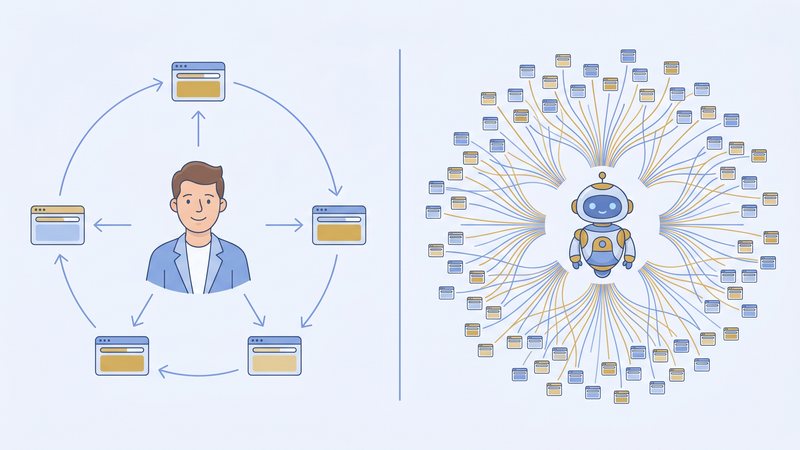
The new bit is the agentic slice. It’s still tiny in absolute terms, but it’s the bit growing in triple digits. Prince’s framing on stage at SXSW was that an agent will often visit roughly 1,000 times the number of sites an actual human would for a single decision (TechCrunch interview). That’s the multiplier that matters for marketing, not the headline 57.4%.
So no, this isn’t overhyped. It’s a real shift, it’s accelerating, and the slice that affects advertising is the one growing fastest.
If a bot is doing the buying, what happens to the buying journey?
Here is the bit that scrambles a lot of marketing assumptions.
For decades, the consumer journey worked roughly like this. A person decides they need something, runs a few searches, visits a handful of websites, reads some reviews, gets nudged by retargeting ads for two weeks, eventually picks one. GE Capital’s classic shopper study put the average at five retailers visited and 79 days of research for a major purchase (GE Capital Retail Bank study). That number has been the load-bearing assumption inside every marketing funnel diagram I have ever drawn for a client.
An agent does not browse like that.
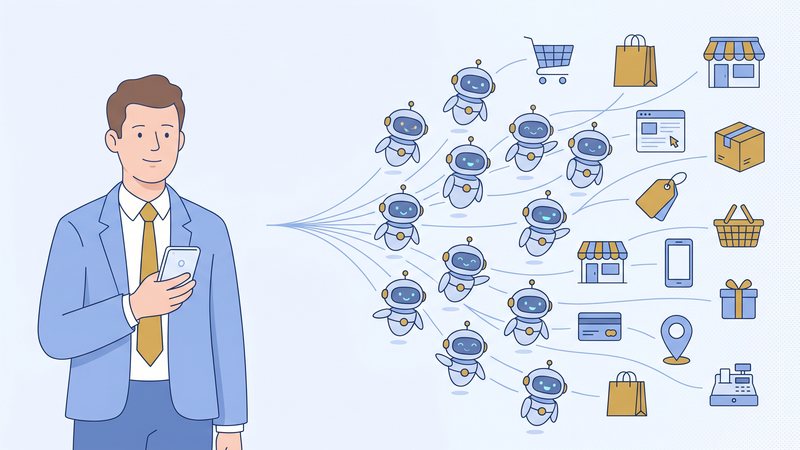
When you ask Perplexity to find you the best mid-range running shoes, or you point ChatGPT at a problem and ask it to recommend a product, the assistant fans out across far more sources than a human would ever bother with. Hundreds. Sometimes thousands, when it spiders product reviews, forum posts, comparison sites, manufacturer spec sheets and recent news. It does not get tired. It does not get retargeted. It does not click a Facebook ad on the way and end up at a different shop entirely. It comes back with two or three options and a justification.
The visit pattern flips. Humans visit a few sites and make a decision. Agents visit huge numbers of sites to make the same decision faster, and the human visits exactly one URL: the checkout. That click is the last step now, not the first.
You can already see this in the conversion data. Adobe’s Q1 2026 AI Traffic Report found AI-referred traffic converted 42% better than non-AI traffic in March 2026, and produces 37% higher revenue per visit. A year earlier, the same comparison ran 38% worse for AI traffic (TechCrunch on the Adobe report). Those visitors are not researching when they land. They have already decided.
Don’t bots ignore advertising?
Mostly, yes. And this is the part nobody quite knows what to do with.
An AI agent comparing twelve coffee machines does not get distracted by the banner ad at the top of the comparison article. It does not have a wandering eye, a curiosity reflex, or a fear of missing out. It reads what’s on the page, weighs it against everything else, and moves on. Retargeting cookies bounce off it because there is no continuous human session to retarget. Display ads sail past. Sponsored content gets clocked as sponsored, then either ignored or downweighted.
This is not theoretical. The McKinsey QuantumBlack team published a piece on agentic commerce flagging it bluntly: brands relying on sponsored placements, display, and keyword-based ads lose visibility and attribution when agents bypass search interfaces. eMarketer projects US advertisers will spend roughly $72 billion on retail media in 2026, up around 18% on 2025, on a channel agents are partially designed to ignore. That’s a lot of money flowing toward eyeballs that are increasingly closed.
The contrarian take, though: advertising isn’t dying. It’s splitting into two audiences with completely different needs, and most brands are still pitching to only one of them.
Humans need persuasion: brand affinity, social proof, mood, story. Agents need facts: price, spec, stock, shipping, schema markup it can parse without guesswork. The agent doesn’t care that your product photography is gorgeous. It cares that the canonical price field hasn’t lagged the actual price by three weeks. The human at the other end of the agent’s recommendation still has to be sold to, but they’re now being sold to twice removed, through a recommendation engine they trust more than your ad.
Brands that win the next decade will advertise to both. Most are currently advertising to neither, properly.
What is Meta actually trying to build?
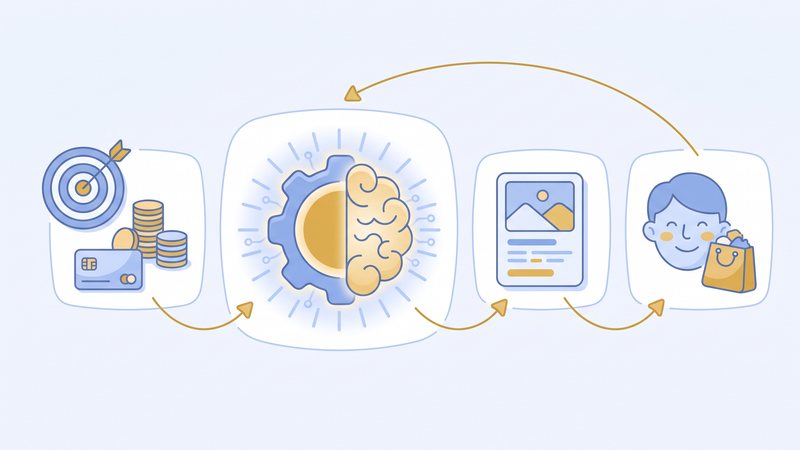
Mark Zuckerberg has been weirdly explicit about this. At Meta’s 28 May 2025 shareholder meeting he said, verbatim: “any business will be able to just tell us what objective they’re trying to achieve, like selling something or getting a new customer, how much they’re willing to pay for each result, and connect their bank account and then we just do the rest for them.” (Yahoo Finance coverage). Reporting in the Wall Street Journal the following month said Meta has set an end-of-2026 internal deadline to make this real (Benzinga summary of the WSJ report).
Take that seriously, because the implication is bigger than “easier ad creative”.
What Meta is describing is a closed loop. You feed in goal + budget + bank details. Meta’s system writes the copy, generates the imagery and video, picks the audience, runs the test, kills the losers, scales the winners. The creative team disappears from the process. The media buyer disappears from the process. The planner disappears from the process. What’s left of “the agency” is a person checking that the bank account hasn’t drained too fast.
Now layer this on top of the bot-buyer shift. If Meta’s machine is writing the ad, and the ad’s job is partly to influence agents that recommend products, and the agents themselves are talking to brand catalogues directly, you end up with software talking to software talking to software. The humans are at the very edges of the pipe: setting an objective on one side, occasionally clicking a confirmation on the other.
That isn’t a doomsday scenario. It’s a recognisable industrial pattern. The same thing happened to programmatic display, to algorithmic stock trading, to Google’s responsive search ads. Each step removed a layer of human judgement from a process that used to need lots of it. Meta is simply applying that pattern to the whole campaign, end to end, rather than just bits of it.
The bit worth pushing back on: a machine optimising toward an objective will find the cheapest path, not the right one. If your bank-and-button setup tells Meta “get me leads at £8”, you’ll get leads at £8, and quite a lot of them will be rubbish. Optimisation without taste is how brands end up running ads next to extremist videos at 3am and finding out only when the screenshots hit Twitter. The “we do the rest for you” pitch hides the question of who is checking what the rest actually is.
How will purchases actually be made in this new setup?
A worked example, because abstract is unhelpful.
Imagine you want a wireless lapel mic for a podcast. You ask ChatGPT, or Comet, or whichever assistant you’ve set up to act as your shopping agent. You give it a price ceiling and a constraint or two (“must work with iPhone, decent in windy conditions, available in the UK”). The agent goes off and pulls product data from Amazon, John Lewis, B&H, manufacturer sites, plus reviews from Wirecutter, Reddit threads, YouTube creator videos, transcribed if needed. It scores the options against your stated needs. It surfaces two or three with a one-paragraph rationale and the price each is at right now. You pick one. It buys it.
In that loop, the things that influenced your purchase were:
- Whether your product data could be cleanly read by the agent
- Whether independent reviewers covered you fairly
- Whether your price was within range on the day
- Whether your stock and shipping data were accurate enough to trust
- Whether your brand had enough mentions, across enough credible sources, for the agent to rank it confidently
The things that did not influence it: your Facebook ad, your retargeting pixel, your billboard at Old Street, your beautiful brand photography, your influencer deal from last quarter. None of that touched the decision because the human never saw it during the decision phase. They might see it weeks later, on a separate Instagram scroll, and remember the brand fondly. But not during the buy.
This is why people in retail are quietly losing sleep. McKinsey reckons agentic commerce could orchestrate up to $1 trillion in US B2C retail revenue by 2030, with global numbers reaching $3 to $5 trillion (McKinsey QuantumBlack analysis). Even if that estimate’s enthusiastic by half, the lower bound is enormous, and almost none of the standard marketing playbook reaches it.
What should you actually do before the end of the year?
A short list, in priority order. None of these are speculative. All of them are doable inside any small or mid-sized business in the UK with the right brief.
Get your product data into agent-readable shape. Structured schema markup, GS1-compliant identifiers, canonical product pages, clean feeds. If your inventory system lies to your website about stock, fix that first, because an agent that gets burned once on availability stops recommending you. Syndigo and others have written this up in detail (agentic commerce data piece), and the work is unglamorous but load-bearing.
Audit what AI assistants already say about you. Ask ChatGPT, Perplexity, Claude and Gemini variations of “recommend me [your category] in [your area]”. Note what comes back. Note what doesn’t. The brands the assistants name without prompting are the ones in pole position. If you’re never mentioned, that’s the gap. I wrote a longer playbook for this in Getting Cited By AI: The GEO Playbook and the steps still hold.
Treat brand mentions as a ranking signal. Agents are weighting how often credible third parties mention your brand, in what tone, near which categories. PR, podcast appearances, expert quotes in trade press, Reddit threads where actual humans defend you, all of that compounds. Cheap link-building does not. The detector is reading the room, not the URL count.
Run your Meta ads with the assumption that something else is steering them. If you’re on Advantage+ already, you’ve felt this. The platform makes choices you don’t fully see. Set guardrails: clear excluded audiences, capped daily budgets, frequent creative refresh, weekly human review of where your spend actually went. The “set objective, connect bank account” world is coming whether you want it or not. Make sure you’re the one defining the objective sharply, because anything you leave fuzzy, the machine will resolve in the cheapest possible direction.
Keep at least one channel that the agents can’t sit between. Email. SMS. A community on a platform you control. Direct relationships with customers who remember your name without having to ask an AI. The brands that survived previous platform shifts (organic Facebook collapse, the iOS 14 ad attribution wipeout, the cookie deprecation drag) were the ones with a direct line. The same will be true here.
None of this is glamorous. None of it is a silver bullet. It’s just the work the next eighteen months requires.
What we’re really preparing for
The web becoming mostly bots is not the headline. The headline is that the consumer journey is being compressed into a single moment, decided inside a system you cannot influence with the marketing tools you currently buy. The five-retailer browse is being replaced by a fifteen-second agent query. The seventy-nine-day research window is being replaced by a recommendation generated while the customer makes tea.
That changes what advertising is for. Not whether it exists, but what it does. Brand-building advertising will matter more, not less, because the human still has to ask for a category by a name. Performance advertising in its current form will matter less, because the agent is doing the performance work for the customer, and your retargeting pixel can’t see it.
If you run a small or mid-sized business, the gap between “ready for this” and “totally unprepared” is currently a few months of focused work. By the end of 2026 it’ll be longer. By 2028 it’ll be the difference between being recommended by default and being invisible.
The brands I’m watching most carefully right now aren’t the ones with the biggest ad budgets. They’re the ones quietly fixing their product feeds, getting quoted in trade press, and earning Reddit defenders. The boring stuff. Right faff to set up. Massive moat once it’s done.
If you want a hand making sense of where to start in your specific business, that’s exactly the kind of thing I help with day to day. Drop me a line via my services page or the contact form and we can map it out properly.