I opened my inbox this morning to find a polite email from OpenAI. Subject: Updates to OpenAI’s Privacy Policy. Body: ads are coming to ChatGPT Free and Go, here is how they will work, here is how to control them. Reassuring tone, sentences in the passive voice, the whole thing reads like a bank letter. Easy to skim past.
Don’t skim past it. For UK ChatGPT users this morning marks the moment ads arrive in the product. Ads went live in the US on 9 February 2026, the UK pilot started in May, and what dropped into my inbox today is OpenAI telling me, as a UK Plus subscriber, that the privacy rules now mention something every Free account here will eventually see. If you’re reading from the US, the launch itself is old news, but the trust, SEO and ad-strategy implications have only just started playing out at scale. If you’re elsewhere, your turn is coming.
So let’s actually unpack what this means, because the “ads in AI answers” story is bigger than ChatGPT, and the most interesting bit isn’t even OpenAI. It’s who said no.
What the email actually says
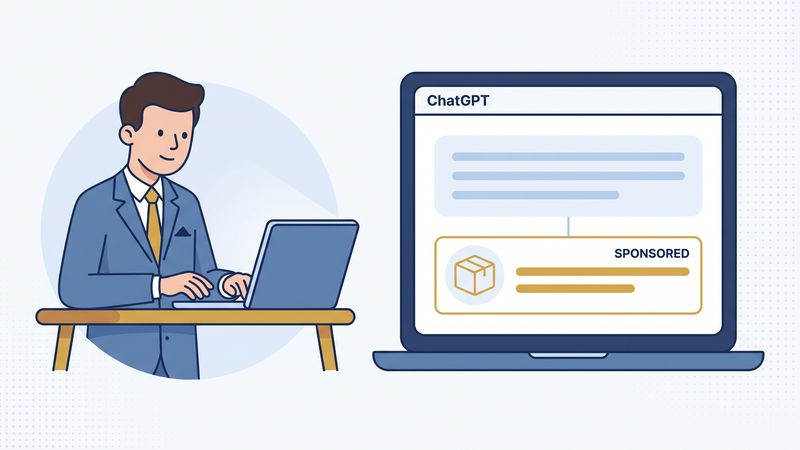
Free and Go users will see sponsored cards at the bottom of relevant ChatGPT responses. The card carries a logo, the word Sponsored, the product name, price, stock, delivery. Plus, Pro, Team, Business, Enterprise and Education tiers stay ad-free. Three categories are off-limits for advertisers: mental health, politics, and under-18 users. OpenAI says ads do not influence the answer ChatGPT gives you, and that personalisation uses signals that “stay only on ChatGPT”. Advertisers get aggregate metrics. They do not see your chats.
That last claim is the one to hold loosely. We’ll come back to it.
Sam Altman’s full U-turn, with receipts
In May 2024 at Harvard, Sam Altman told a room of students that ads-plus-AI was “uniquely unsettling”. He said he hated ads as an aesthetic choice. He called ads a “last resort” and added a line that has not aged well: ads “somewhat fundamentally misalign a user’s incentives with the company providing the service.”
Eighteen months later, on Ben Thompson’s Stratechery podcast, here was the same Sam Altman: “I love Instagram ads, they’ve added value to me, I found stuff I never would’ve found, I bought a bunch of stuff, I actively like Instagram ads.” On 16 January 2026 he tweeted that OpenAI would test ads on Free and a new $8/month Go plan. By February they were live.
For context on the scale of the reversal: when Anthropic ran a Super Bowl spot mocking the ChatGPT ad launch a few weeks later, Altman called the ads “clearly dishonest” and snapped back that OpenAI “would obviously never run ads in the way Anthropic depicts them.” The man who had warned about ads’ incentive problem was now in a public scrap with a competitor about how those ads should be framed.
This stuff matters because OpenAI’s pitch for the past three years has been we are the trustworthy lab. The Harvard quote was free marketing for that pitch. The pivot says something else: when the unit economics get hard enough, founder principles bend. OpenAI is reportedly targeting $2.4 to $2.5 billion in ad revenue this year, and Truist analysts forecast $30 billion by 2030. That’s not a sideline. That’s a second revenue engine being bolted onto the side of the subscription business.
Why OpenAI is the late one, not the leader
Here’s the bit the headlines miss. ChatGPT ads are not first. They’re fourth, maybe fifth, depending on how you count.
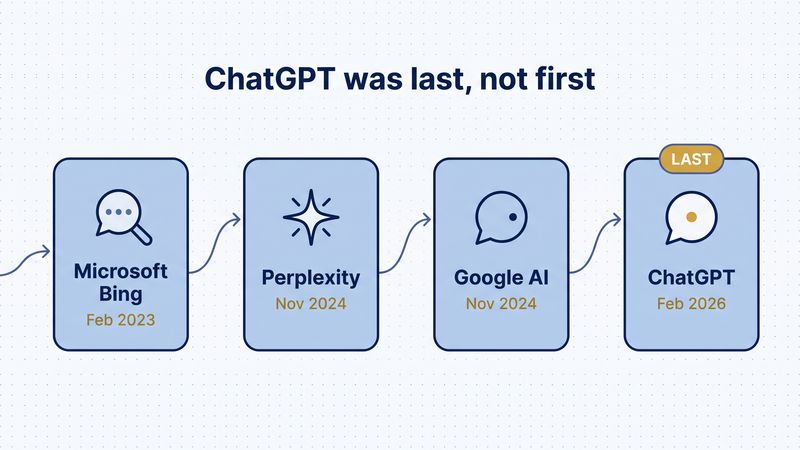
Microsoft has been showing ads inside Bing Chat since launch in February 2023. They’ve since added inline Performance Max ads, a transitional sponsored line that smooths the handover from AI answer to advert, Showroom Ads, and AI Max for Search. Microsoft Advertising reports Copilot ads run at 73% higher click-through and 16% higher conversion than traditional search ads.
Perplexity launched sponsored follow-up questions on 12 November 2024. Launch advertisers were Indeed, Whole Foods, Universal McCann, PMG. CPMs above $50. Aravind Srinivas’s justification was that subs alone couldn’t fund the company’s publisher revenue-share scheme, Comet Plus, which now pays publishers 80% of subscription revenue from a $42.5 million pool.
Google announced ads in AI Overviews at Marketing Live 2024 and rolled them out to US mobile users in November of that year. By 2026 it’s expanded to desktop, to international markets, and is testing ads inside AI Mode. The average AI Overview now carries 15.22 links, up from 6.82 in late 2024.
xAI Grok announced sponsored placements in August 2025. Elon Musk’s framing: advertisers can “pay to appear in suggestions from Grok”, ostensibly to offset GPU costs.
Meta AI doesn’t show ads in chat, but from 16 December 2025 it uses your chats with Meta AI to personalise ads everywhere else on Facebook, Instagram, WhatsApp and Messenger. About a billion people are inside that loop. Zuckerberg’s stated 2026 ambition is fully AI-generated ads where the advertiser submits a bank account and an objective, and the system writes, designs, targets and runs the campaign.
So when OpenAI announced ads in January 2026, it was the last of the big six conversational AIs to do so. The “Sam Altman pivot” headlines got the drama right and the timing wrong.
| AI assistant | Ads in product? | Live since |
|---|---|---|
| Microsoft Copilot / Bing Chat | Yes | February 2023 |
| Perplexity | Yes | 12 November 2024 |
| Google AI Overviews / AI Mode | Yes | November 2024 |
| xAI Grok | Announced | August 2025 |
| Meta AI | No in-chat; chats personalise ads elsewhere | 16 December 2025 |
| OpenAI ChatGPT | Yes (Free + Go) | 9 February 2026 |
| Anthropic Claude | No (publicly committed ad-free) | N/A |
| DuckDuckGo Duck.ai / Brave Leo | No | N/A |
The privacy claim that wobbles when you push it
OpenAI’s email tells you advertisers “only receive overall information” and that your “personal details and conversations are private.” Both true, as far as they go. The bit that doesn’t go quite as far is the unspoken corollary, which is that OpenAI itself now sits between you and a much bigger ad ecosystem.
Three things to know:
-
The 30 April 2026 US privacy policy update quietly added that OpenAI receives purchase data from advertisers for measurement and shares cookie IDs and device IDs with marketing partners. Marketing cookies are on by default for free users. (Search Engine Land coverage)
-
On 13 May 2026 a class-action lawsuit was filed in the Southern District of California alleging OpenAI integrated Meta Pixel and Google Analytics into the ChatGPT web interface, passing chat query topics, user IDs and email addresses to Meta and Google. The case is ongoing, and OpenAI hasn’t admitted the allegation, but the technical claim is well evidenced in the filing.
-
Sara Geoghegan, senior counsel at the privacy nonprofit EPIC, has been making a quieter point that I think is actually the bigger one: the chat interface strips legal protections from sensitive disclosures. People say things to ChatGPT they wouldn’t put in a search box. HIPAA doesn’t follow you in. Neither does GDPR’s purpose-limitation principle once the data lands in a personalisation pile.
None of that means OpenAI is lying. It does mean “personal details stay only on ChatGPT” is a marketing line, not a technical claim. Treat it that way.
Anthropic’s bet, and why it’s interesting
Anthropic, maker of Claude, which is the AI I use day-to-day across automation, development, brainstorming and planning, has gone the other way. Hard. They’ve publicly committed to staying ad-free, said more than 80% of revenue comes from enterprise contracts, and ran a two-spot Super Bowl LX campaign in February 2026 called A Time and a Place, with industry estimates pricing a single 60-second slot at $14 to $15 million. The ads showed Claude conversations interrupted by a fictional ad-supported chatbot pitching things like height-boosting insoles and a dating site called Golden Encounters. Tagline: “A conversation with Claude is not one of them.”
This is unusual. Most AI labs are reaching for any monetisation lever they can find. Anthropic is pricing in the long game: if half the AI market becomes ad-supported, the ad-free positioning becomes a moat. The bet only works if enterprises are willing to pay enough that you don’t need consumer ad revenue. So far they are. Whether that holds at scale is the open question.
DuckDuckGo’s Duck.ai, Brave’s Leo (subscription), and You.com (now mostly enterprise) sit in the same camp on principle, though without the marketing budget. The industry has split cleanly: OpenAI, Google, Microsoft, Perplexity, Meta and xAI on the ad side; Anthropic, DuckDuckGo, Brave on the subscription side. Pick your team.
What this does to search, SEO, and the thing now called GEO
Right, the bit you actually came here for.
ChatGPT processes about 2.5 billion prompts a day and has roughly 900 million weekly active users. A Reuters Institute for the Study of Journalism survey of 280 news media leaders across 51 countries found they expect search referral traffic to drop 43% within three years, with a fifth expecting losses above 75%. The traffic isn’t coming back. The AI answer is the destination now for an increasing share of intent.
This has produced a new acronym you should learn: GEO, generative engine optimisation. You’ll also see AEO, answer engine optimisation, sometimes used interchangeably and sometimes drawn as a separate discipline (AEO focused on direct-answer queries like “what is X”, GEO covering the broader job of showing up inside any AI-generated response). The line is fuzzy and the practitioners themselves disagree. Whichever camp you’re in, the underlying job is the same: get your brand cited inside the AI’s answer. Tools like Profound, AthenaHQ, Scrunch, Adobe’s LLM Optimizer, and Semrush’s AI Visibility Toolkit have appeared in the last 18 months. They do for AI citations roughly what SEO tools used to do for SERP rank: track when your brand is mentioned inside an AI-generated answer, across ten or more engines, and tell you why.
The mechanics are different from SEO. AI answers are synthesised from training data, real-time retrieval, and increasingly from publisher partnerships. Schema markup, entity definitions, clear factual claims with verifiable sources, and brand mentions inside high-authority content all matter more than backlinks do. Keyword density matters less. Being cited matters more than being ranked.
Now bolt ads onto that. Suddenly the page-one real estate problem isn’t just “can I get the AI to mention my brand?” It’s “can I afford to appear in the sponsored card underneath the answer, or do I out-cite the competitors who can?” The two strategies are not the same. CPMs in ChatGPT’s pilot have hit $60 for premium placements. Conversion-optimised campaigns are due to roll out to advertisers on 5 June 2026, two days from today. The auction is starting now.
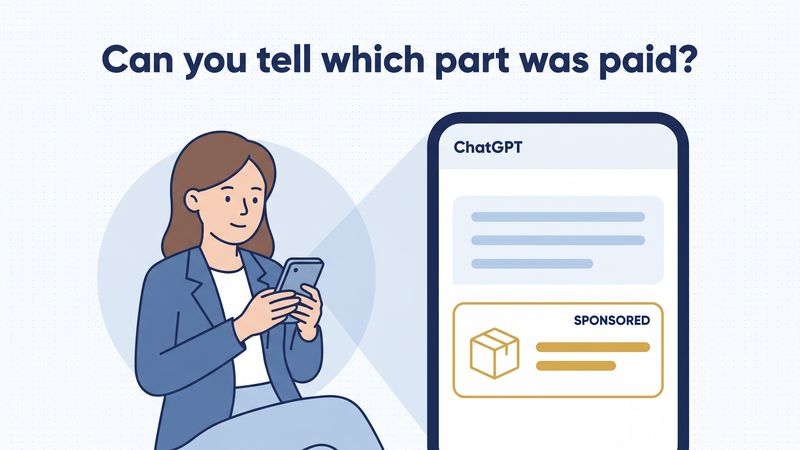
One mildly contrarian take: I think the paid layer in AI is going to feel worse to users than paid search ever did, and I don’t think OpenAI’s “subtle tint” on sponsored cards will hold the trust line. Users have 25 years of training in spotting blue Google ad links. They have zero training in spotting a sponsored answer card. Pew research from October 2025 already shows only 20% of US adults find AI summaries “extremely or very useful”. Add commercial intent to that mix and the gap between “the AI told me” and “the AI was paid to suggest that” closes very fast. That’s the trust cost OpenAI is borrowing against.
The regulatory squeeze
Three regulatory dates worth knowing this year.
March 2026: UK CMA guidance already issued. The line worth remembering: “The fact that an AI agent, not a human, performed a function does not reduce a business’s obligations under consumer protection law.” If you deploy AI in your marketing, you own the liability, not the model provider.
May 2026: US FTC updated its endorsement guidance. If you use a synthetic influencer, you now need two disclosures: that the post is paid, and that the endorser is AI. Up to $53,088 per violation.
2 August 2026: EU AI Act Article 50 transparency rules apply. AI-generated text on matters of public interest must be labelled. Synthetic audio, image and video must be machine-readable marked. Penalties up to €15 million or 3% of global turnover.
This regulatory pattern matters because it’s where the ad-vs-answer line gets enforced. OpenAI’s “Answer Independence” principle is a private promise. Article 50, the CMA, and the FTC are turning that promise into a legal obligation, with teeth. Expect more enforcement, not less.
| Date | Jurisdiction | What it does | Maximum penalty |
|---|---|---|---|
| March 2026 | UK CMA | AI agents do not reduce business liability under consumer law | Existing consumer-law penalties |
| May 2026 | US FTC | Synthetic influencer needs two disclosures: paid + AI | $53,088 per violation |
| 2 August 2026 | EU AI Act, Article 50 | AI-generated text on public-interest topics must be labelled | €15M or 3% of global turnover |
What UK marketers should actually do this quarter
Not a tidy listicle, just three things that move the needle.
Audit how your brand currently appears in AI answers. Run your top 30 customer questions through ChatGPT, Gemini, Perplexity, Copilot and Claude. Note where you’re cited, where you’re invisible, and where a competitor owns the answer. This is the new baseline metric. GEO tools help but a manual pass first will teach you more about your category than any dashboard.
Treat AI ad placements as a 2026 to 2027 test budget, not a 2026 plan. Robert Webster at the consultancy TAU made a smart point in Digiday: nobody, including OpenAI, yet knows what a ChatGPT user is worth. The auction is forming. Reserve a small budget, run an isolated campaign with clean attribution, and resist letting your agency spread it across channels. You’re buying learning, not conversions, for now.
Get your factual ground right. AI ad copy is generated, AI organic mentions are synthesised, and both lean heavily on whatever your site actually claims. Vague positioning gets you skipped. Specific, verifiable, sourced claims get you cited. “A Midlands-based plumber” beats “a local business”. Real numbers beat “high conversion rates”. The brands that show up in AI answers are the ones that wrote things AI could quote.
One last thing
The reason this matters is bigger than ad budgets. For 25 years, the deal between you and search was implicit and well understood: ten blue links, three or four ads at the top, you knew which was which. That deal is being rewritten in conversation form, and the new deal hasn’t been negotiated with anyone. We’re finding out the rules by living through them.
The email from OpenAI this morning was pleasant. It was also a quiet announcement that the assistant on your phone is now also a sales channel. Worth knowing, even if the formatting is bank-letter.
If you want to think about what this means for your own marketing, drop me a line and we can talk it through.