
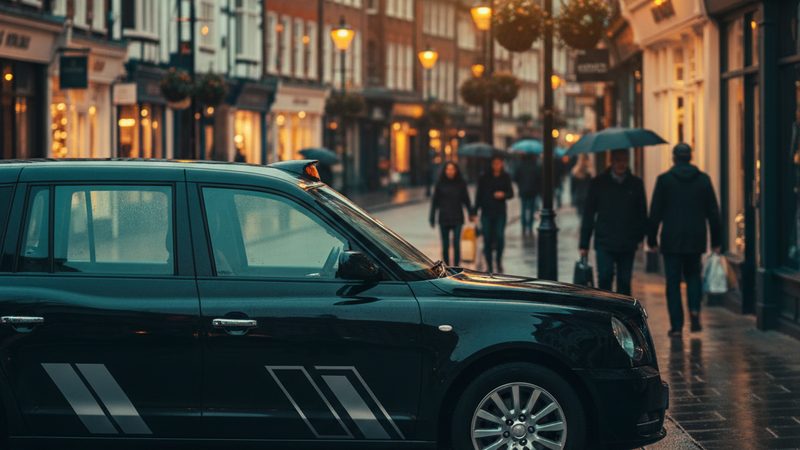
Advertising a taxi company in 2026 is a local, mobile, and increasingly AI-driven game. Your customers decide in seconds, usually on a phone, often while standing on a pavement in the rain. Your job is to be the obvious answer at that exact moment. This guide walks through the seven strategies that still move the needle this year, why each one matters, and how to put them to work without wasting money on channels that do not convert.
Why Local Advertising Matters for Taxi Companies
Taxi demand is hyperlocal and time-sensitive. People searching for a ride need one now, in their area, and they rarely scroll past the first handful of results. Being visible at that exact moment is the difference between winning or losing the booking. Unlike most businesses, you are not competing on considered purchase decisions. You are competing on whoever shows up first, answers the phone fastest, and looks trustworthy enough to get into the car with.
That is why the strategies below are weighted toward visibility, speed, and trust signals. Everything else is secondary.
7 Effective Strategies to Advertise Your Taxi Company Locally
1. Google Business Profile: Your Single Highest-Leverage Channel
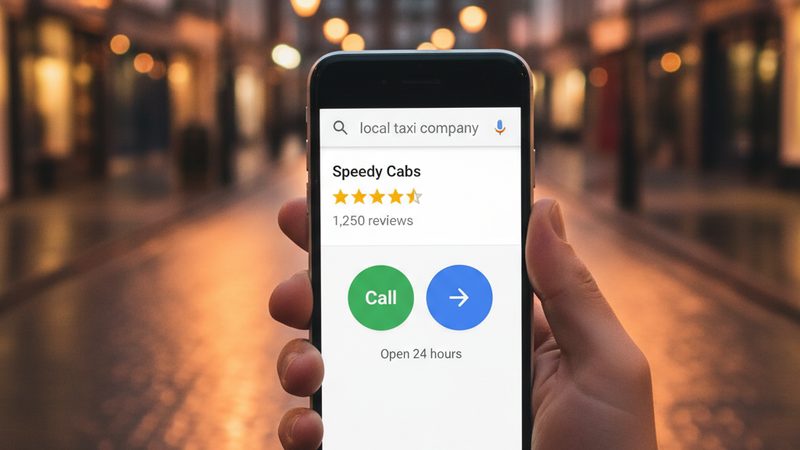
Claiming and optimising your Google Business Profile (formerly Google My Business) is still the single most impactful free action you can take. When someone searches “taxi near me” or “taxi in [your town]”, Business Profiles appear prominently above organic results, often with a tap-to-call button that skips your website entirely.
What to do in 2026:
- Claim and verify your free listing at business.google.com
- Add your full address, phone number, operating hours (including bank holidays), and service area
- Upload at least 15 high-quality photos of your vehicles, drivers in uniform, and any signage
- Turn on messaging if you can answer quickly, and call tracking if your dispatcher can manage it
- Post updates weekly: promotions, seasonal availability, airport run specials
- Actively collect reviews and respond to every single one
Google’s local ranking factors reward activity. A profile that is updated weekly consistently outperforms one that is claimed and forgotten, even when the forgotten profile belongs to a bigger company. Put 20 minutes a week into this and it will pay you back faster than any paid channel.
2. Local SEO and AI Search Visibility
Beyond your Business Profile, your website needs to rank for the searches your customers actually type. Think “taxi company Reading”, “Reading airport transfer”, “Reading to Heathrow taxi”, and “24 hour taxi near me”. The fundamentals are unchanged: a fast, mobile-first site, a dedicated page for each major route or service area, and the city or town name used naturally in titles, headings, and descriptions. No keyword-stuffing, just write like a human who lives there.
What has changed in 2026 is where customers search. A meaningful share of ride-booking queries now happen inside AI assistants and AI-enhanced search: Google’s AI Overviews, ChatGPT, Perplexity, and Gemini. These tools pull from structured data, business listings, and well-organised web content. To stay visible:
- Add LocalBusiness schema markup to your homepage and service-area pages
- Keep your NAP (Name, Address, Phone) consistent across every directory
- Build citations on Yelp, Yell, Checkatrade, Thomson Local, and your council’s business directory
- Write clear, answer-style content for common questions (“how much is a taxi from Reading to Heathrow?”)
- Earn backlinks from local sources: community blogs, regional press, hotel and venue partners
Local SEO compounds. A year of consistent work will outperform almost any short burst of paid advertising, and the traffic keeps coming long after you stop.
3. Google Ads for High-Intent Searches
Google Ads is where you capture the “I need a taxi right now” moment. Unlike SEO, it is instant. You appear at the top of the page the day you launch, and you only pay when someone clicks or calls.
What works for taxi companies in 2026:
- Target high-commercial-intent keywords: “book taxi”, “taxi service near me”, “airport taxi [town]”
- Use call-only and call extensions on every campaign — most taxi bookings still happen by phone
- Set tight location targeting so you only show ads inside your actual service area
- Use ad scheduling to bid heavier during peak hours: Friday and Saturday nights, early-morning airport runs, school-run times
- Separate branded and non-branded campaigns so you know which budget is doing the real work
- Track conversions with call tracking or unique numbers per campaign, otherwise you are flying blind
One tactical tip: resist Google’s push to throw everything into fully automated Performance Max campaigns. For small taxi operators, tightly managed Search campaigns with call-focused conversions almost always deliver better return per pound than Performance Max’s broader reach.
4. Meta Ads (Facebook and Instagram) for Local Awareness
Meta’s ad platform is excellent for building top-of-mind awareness in your area. Unlike Google Ads, which captures existing demand, Facebook and Instagram create demand by putting your brand in front of people before they need you. When the moment comes and they do need a ride, you are the name they remember.
Effective approaches in 2026:
- Target a tight radius (3–10 miles) around your operating area using postcode targeting
- Run specific offer ads, not generic “come ride with us” creative: 10% off airport transfers, flat-rate night fares, booking-app download incentives
- Use short vertical video showing clean vehicles, smiling drivers, and the booking experience
- Retarget anyone who visited your website but did not call or book
- Promote to local community interest groups: parents, commuters, students, nightlife audiences
- Keep creative fresh — swap out visuals every 2–3 weeks to fight ad fatigue
With Apple’s App Tracking Transparency and ongoing iOS privacy changes, Meta targeting is less precise than it was a few years ago. Counter this by investing in strong creative and a specific offer rather than relying on the algorithm to find perfect users. A sharp offer with okay targeting beats perfect targeting with a dull offer every time.
5. Partnerships with Local Businesses
Partnerships are the most underrated strategy on this list. They cost almost nothing, they generate repeat revenue, and they lock out your competitors. Build relationships with the businesses that regularly need taxis for their customers or staff:
- Hotels and B&Bs for airport transfers, late-night pickups, and guest runs
- Restaurants, pubs, and bars for safe-ride promotions and last orders pickups
- Corporate offices for regular employee transport and client runs
- Hospitals, care homes, and clinics for patient and visitor transport
- Event venues, wedding planners, and nightclubs for group bookings
Offer a referral fee, a preferential account rate, or a direct-dial dispatch number in exchange for becoming their default choice. Keep the arrangement simple, pay on time, and show up reliably. A single hotel partnership can generate more monthly revenue than most paid campaigns, and it runs on autopilot for years.
6. Reviews and Reputation: The Quiet Multiplier
Reviews drive more taxi bookings than almost anything else, because trust matters disproportionately in a business where customers are literally getting into a stranger’s car. A 4.7-star profile with 200 reviews will beat a 4.9-star profile with 20 reviews, and both will wipe the floor with a company that has none.
How to earn more reviews, ethically:
- Never buy reviews or pay for them — Google and Trustpilot actively punish it, and customers see through it
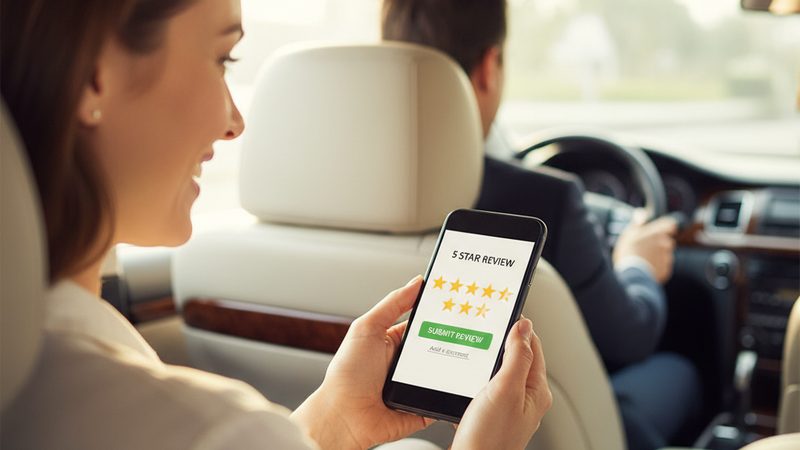
- Ask at the right moment: when the customer thanks the driver and gets out of the car
- Use Google Business Profile’s review shortlink and print it on a small card drivers hand over with the receipt
- Send a short follow-up SMS or email with a one-tap review link for account and app customers
- Train drivers to mention it only when the customer is clearly happy — pushy asks hurt more than they help
Respond to every review, positive and negative. A calm, professional reply to a one-star complaint often does more to reassure future customers than the original complaint does to put them off. Silence, on the other hand, reads as guilt.
7. Vehicle Branding and Driver Experience: Moving Billboards That Build Trust
Your vehicles are the most visible and most under-used advertising asset you own. Every mile they drive is an impression, and unlike paid media, you have already paid for the vehicle. Make it work harder:
- High-quality vinyl or magnetic signage with your company name, a memorable phone number, and a booking URL short enough to read at a glance
- A memorable phone number is worth more than any clever slogan — short, rhythmic, easy to recall
- Spotless, well-maintained vehicles — the car itself is a trust signal, and a dirty car erases every pound you spent on Google Ads
- Branded driver uniforms, even just a polo shirt and lanyard, signal professionalism at the kerbside
- A clean, consistent interior: fresh air, a charging cable, a card reader — small things customers tell friends about
In 2026, the “customer experience starts when the car pulls up” principle has become marketing itself. The drivers who get tipped, get repeat bookings, and get recommended are the ones who turn a functional ride into a small, memorable moment. Word of mouth is still the most trusted form of advertising, and your drivers generate it one fare at a time.
Measuring What Actually Works
You do not need a complicated dashboard. You need a handful of numbers reviewed weekly:
- Google Business Profile insights: views, calls, direction requests, website clicks
- Call tracking: a unique phone number for each major channel so you know which ads generate real bookings, not just clicks
- Google Analytics (or a simple alternative like Plausible): which pages and sources drive the most conversions
- Booking-to-fare conversion rate: what percentage of enquiries turn into actual paying jobs
- Repeat customer rate: the quiet engine of profitability
- Review volume and average rating: the leading indicator of everything else
If something is not working after 60 days, change it. If something is working, spend more on it. Most small taxi companies lose money by doing a bit of everything badly rather than a few things well.
Summary
The most effective taxi advertising strategy in 2026 combines:
- A fully optimised Google Business Profile updated weekly — free, highest ROI
- Local SEO and AI search visibility for long-term, compounding traffic
- Google Ads for immediate visibility on high-intent “taxi near me” searches
- Meta Ads to build local brand awareness before the moment of need
- Local business partnerships for consistent, recurring revenue that competitors cannot easily copy
- A steady flow of reviews handled ethically and responded to personally
- Branded vehicles and professional drivers as trust signals and moving billboards
Start with the free channels — Google Business Profile, local SEO, reviews, partnerships — and get them genuinely working before spending a penny on paid advertising. Once you understand which customers are most profitable and which channels bring them in, layer in Google Ads and Meta to accelerate. That sequence turns marketing from a cost into a predictable source of growth.
Need help turning this into a plan for your taxi company? Book a free 30-minute Growth Audit and I’ll show you exactly where your biggest opportunities are.