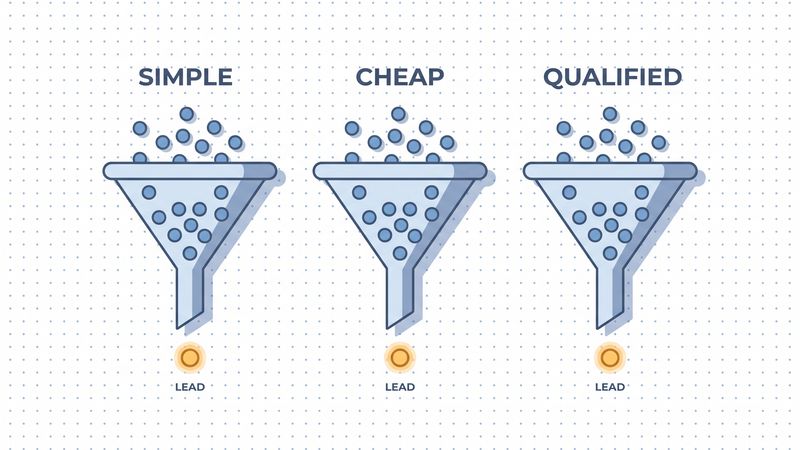
Most people ask the wrong question about funnels. They ask “what’s the best sales funnel” as if there’s one winning shape everyone should copy. There isn’t. A funnel built to capture leads as cheaply as possible looks nothing like one built to hand your sales team only people who are ready to buy. Same word, different machine.
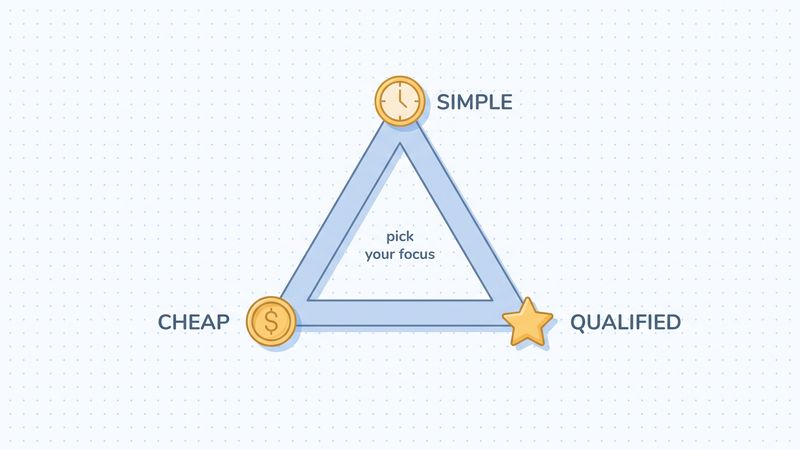
So the better question is: best at what? Cheapest leads, fastest to launch, or highest-quality leads. You can lean hard into one. You cannot have all three at full tilt, and any guide that promises you can is selling you something.
This piece sorts that out. You’ll get the four stages every funnel shares, the three goals a funnel can chase, a plain build for each, and a side-by-side table so you can pick the one that fits where your business is right now. The numbers throughout are 2026 benchmarks, mostly US data, but the patterns hold whether you’re in Birmingham or Boston.
What a sales funnel actually is
Strip away the jargon and a sales funnel is just the path a stranger takes to becoming a customer, broken into stages so you can see where people fall out.
Four stages cover it:
- Attract. Someone who’s never heard of you notices you. An ad, a search result, a post, a referral.
- Capture. They give you a way to reach them again, usually an email address, in exchange for something useful.
- Nurture. You build a bit of trust over days or weeks. Emails, useful content, the odd nudge.
- Convert. They buy, book, or enquire.
That’s it. Awareness, then permission, then trust, then the sale. Some marketers slice it into six or seven stages and give each a Latin name. For a small business that’s mostly theatre. Four is enough to find the leak.
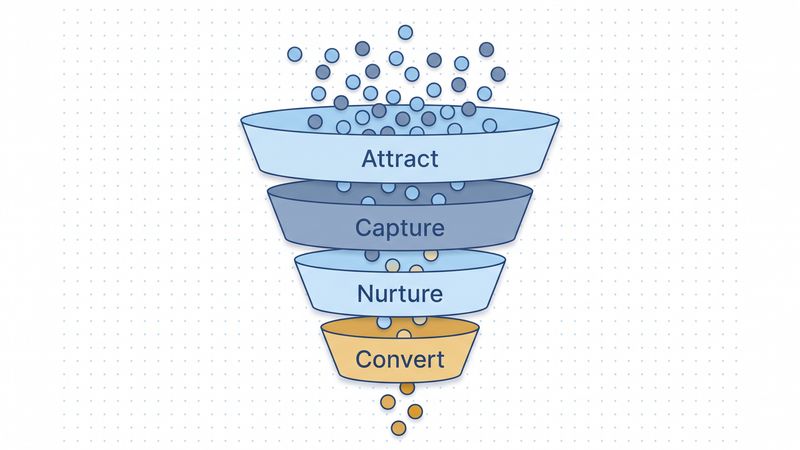
And here’s the bit the diagrams never show. The funnel is leaky on purpose. People are meant to drop out at each stage, because the ones left at the bottom are the ones worth your time. A funnel that lets everyone through to the sales call isn’t a funnel. It’s a queue.
First, pick your goal
Before you build anything, decide what you actually want this funnel to do. There are three honest goals, and they pull against each other.
- Speed and simplicity. You want something live in weeks, not months, that you can run yourself without a marketing team.
- Cost. You want each lead as cheap as you can get it, because your margins or your budget are tight.
- Quality. You want fewer leads but better ones, so your time goes to people who’ll actually buy.
Now the awkward truth. Chase the cheapest leads and you’ll get volume, but a chunk of them will be tyre-kickers who’ll never pay, so quality drops. Filter hard for quality and your cost per lead climbs, because you’re throwing away cheap-but-weak prospects on purpose. Build for quality and low cost and speed all at once and you’ll get a wonky, half-finished thing that does none of them well.
Pick the corner that matches your situation. A brand-new business with no list should chase speed first. A business drowning in unqualified enquiries should chase quality. A business with a working offer but skinny margins should chase cost. The rest of this guide is one funnel per corner.
The simplest funnel: live in weeks, run by you
If you’ve never built a funnel, build this one. It has three moving parts and you can put it together with tools you probably already pay for.
One offer. A single thing you want people to do at the end. Book a call. Request a quote. Buy the entry product. Not three options. One.
One landing page with a lead magnet. A lead magnet is the useful thing you give away in exchange for an email: a checklist, a short guide, a free audit, a calculator. Keep it narrow and fast to use. The right lead magnet for the right audience can convert anywhere from 25% to 50% of landing-page visitors, while a vague or bloated one limps along at 1% to 3%, according to analysis of lead magnet performance. For service businesses, free audits and checklists tend to land in the 18% to 32% range. The median landing page across all industries sits at about 6.6%, per Unbounce’s data, so even a middling lead magnet beats sending traffic to your homepage.
One follow-up sequence. Five or so emails over a couple of weeks. Useful, not pushy. Each one earns the next. The last one makes your offer.
That’s the whole build. A landing page, a lead magnet, a five-email sequence, and one traffic source can be live in two to four weeks, and you’ll want two or three months before the conversion numbers settle enough to trust them.
Why start here even if you’re ambitious? Because the most common reason funnels fail is overcomplication. People bolt on quizzes, tripwires, upsells and webinars before the basic path works, then can’t tell which part is broken. Get one simple funnel converting first. Add the clever bits later, once each one has a job to do.
I watched a local installer do the opposite last year. Lovely ads, decent budget, all of it pointing at a contact form with eleven fields. He’d built the funnel back to front: heavy at the top, broken at the bottom. We cut the form to three fields and added a single follow-up email. Same traffic, far more enquiries. The fix wasn’t more funnel. It was less.
The cheapest-leads funnel: squeeze the cost down
This funnel is for when the offer already works and the job is to bring the cost per lead down. Two things drive that cost: which channel you use, and how much friction sits between the click and the capture.
Channel first, because the spread is enormous. Here’s roughly what a lead costs across common channels in 2026.
Average cost per lead by channel, 2026 (US benchmarks, USD)
A referral lead costs around $25. A trade-show lead costs around $840, according to Sopro’s channel benchmarks. That’s a 33x gap for a lead in the same business. The cheapest-leads funnel leans hard on the cheap end: referrals, organic content, and tightly targeted paid ads where the intent is high. Google Ads sits around $70 per lead on average across industries, Meta around $27 for e-commerce, per LanderLab’s 2026 benchmarks. The blended cross-industry average is roughly $198, dragged up by the expensive channels most small businesses don’t need.
Then there’s friction, and this is where money quietly leaks. One analysis found that a poorly built funnel can push cost per lead up to $150 simply because of all the steps between clicking the ad and reaching the business. Every extra page, every extra form field, every “create an account to continue” loses a slice of people you already paid for. Strip the path back. One page, one short form, one clear next step. You’re not paying for fewer clicks. You’re keeping more of the ones you bought.
A word of caution, though. Cheap leads are still only worth chasing if some of them buy. The right target cost per lead is a function of your lifetime customer value and your close rate, not a number off a benchmark chart. A £40 lead is dear if nobody converts and a steal if one in five becomes a £3,000 customer. Cheap is a means, not the goal.
The best-qualified-leads funnel: fewer, better, ready to buy
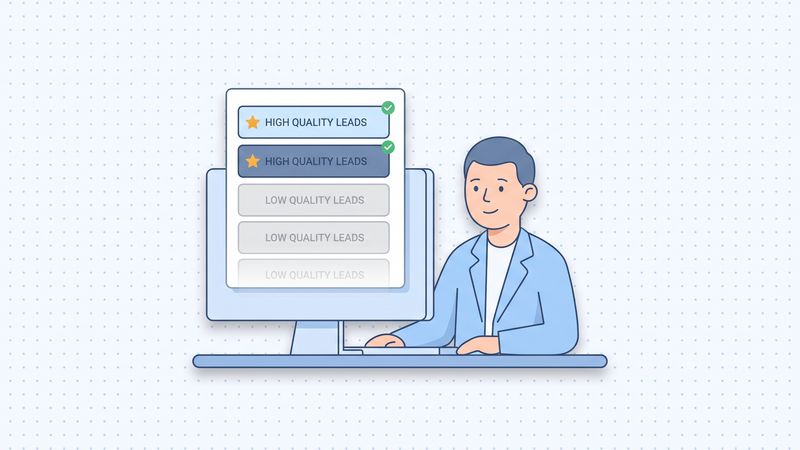
This funnel is for service businesses and anyone whose time is the bottleneck. The aim isn’t more leads. It’s making sure the people who reach your calendar are worth the call. One good lead can be worth hundreds or thousands of pounds, so a funnel that filters well pays for itself fast.
It works by doing the opposite of the cheap funnel. Instead of removing friction, you add the right friction, the kind that filters out people who were never going to buy.
Ask qualifying questions at capture. Budget, timeline, the problem they’re trying to solve. A few honest questions on the form mean the weak-fit leads bow out themselves, and the ones who stay have told you they’re serious.
Score the leads you get. A simple scoring model splits browsers from buyers. A modern approach weights behavioural signals, fit, and intent into a single score out of 100, as set out in this 2026 framework. You don’t need software for the basic version. A demo request or a pricing-page visit scores high. A single blog read scores low. Spend your follow-up energy on the high scores.
Why bother? Because most businesses don’t, and it shows. Research found 61% of B2B marketers pass every lead straight to sales, yet only 27% of those leads are actually qualified, according to lead qualification data. Marketing-qualified leads convert to sales-qualified at around 13% on average; the best B2B teams push close to 40%. The gap between those numbers is mostly qualification done properly.
And then the single most overlooked lever in the whole funnel: speed. Contact an inbound lead within five minutes and you’re 21 times more likely to qualify them than if you wait 30 minutes. That figure comes from a landmark study by James Oldroyd and colleagues, published in Harvard Business Review, which examined response times across more than 2,000 US companies. Separately, sales research puts it even more starkly: 78% of customers buy from the business that responds first. Not the cheapest. Not the best. The first. A qualified-leads funnel without fast follow-up is a sieve with a lid.
The three funnels, side by side
Here’s the whole thing in one view. Find the row that sounds like your business and read across.
| Simplest funnel | Cheapest-leads funnel | Best-qualified funnel | |
|---|---|---|---|
| Goal | Get live fast | Lowest cost per lead | Highest-quality leads |
| Effort to build | Low | Medium | Medium to high |
| Lead cost | Medium | Low | Higher |
| Lead quality | Mixed | Mixed to low | High |
| Best for | New businesses, first funnel | Tight budgets, working offer | Service firms, limited time |
| Main risk | Outgrowing it | Tyre-kickers | Fewer total leads |
| Key move | Keep it to one offer | Cut friction and channel cost | Qualify and follow up in 5 minutes |
Notice none of them is “best” in the abstract. The right one is the one that matches your constraint. Short on time? Simplest. Short on cash? Cheapest. Drowning in junk enquiries? Qualified. Most businesses know which corner they’re in the moment they read the table.
The mistakes that sink all three
Whichever funnel you pick, the same handful of errors will quietly kill it. Worth knowing them before you build.
A weak offer. This is the big one. No funnel rescues an offer nobody wants. If the thing at the bottom doesn’t clearly solve a real problem, every stage above it is wasted motion. Fix the offer before you touch the funnel.
All capture, no nurture. Plenty of businesses pour effort into getting the email, then do nothing with it. Most people who hand over their details aren’t ready to buy that day. Drop them and you’ve paid for a lead you then threw in the bin. The nurture sequence is where the money is.
Too many steps. Said it already, saying it again, because it’s the most common build mistake. Every extra stage between stranger and sale is somewhere to lose people. When in doubt, take a step out.
No clear call to action. Astonishingly, 70% of B2B small businesses say they don’t use a strong call to action. People won’t guess what you want them to do. Tell them, plainly, once per page.
Slow follow-up. Worth repeating from the qualified-leads section, because it applies to all three funnels. A lead that goes cold in your inbox for a day is usually a lead lost to whoever replied first.
So which one do you build?
Start with your goal, not the funnel. If you’re new to this, build the simplest version, get it converting, and resist the urge to add clever bits before the basics work. If money’s tight, build the cheap funnel: lean channels, no friction, and a clear-eyed view of what a lead is actually worth to you. If your problem is junk enquiries eating your week, build the qualified funnel, ask better questions up front, and answer fast.
You can always add complexity later. The mistake is starting with it. Pick one goal, build the one funnel that serves it, and let it earn the next thing you bolt on.
If you’d rather not piece it together yourself, that’s the sort of thing I help businesses build through lead generation and automation. And if you just want a second pair of eyes on a funnel that isn’t pulling its weight, get in touch and we’ll find the leak.