
Winning a cleaning client is a trust exercise before it is anything else. Someone is about to hand a stranger the keys to their house, or the alarm code to their office, and they will make that decision in a few minutes, usually on a phone. So if you want to know how to get clients for a cleaning business in 2026, the honest answer is this: be the obvious safe choice at the exact moment somebody goes looking. This guide walks through seven ways to do that, in the order I would do them, with the free channels first and the paid ones last.
Why Getting Clients for a Cleaning Business Is a Different Game
Most marketing advice treats every sale as a one-off. Cleaning does not work like that. A weekly domestic clean at £20 an hour is worth roughly £2,000 a year, and a decent office contract is worth far more, year after year, for as long as you keep showing up. Win one client and you have not won a job. You have won fifty.
That changes the maths on everything below. You can afford to work harder, and spend more, to land one recurring client than almost any other local business can. It also means retention quietly outranks acquisition: keeping the clients you already have is the cheapest growth there is.
The competition looks scarier than it is. The UK cleaning sector counts around 79,000 businesses, and the wider cleaning, hygiene and waste industry employs about 1.5 million people, roughly 5% of the UK workforce, according to the British Cleaning Council’s 2026 research. But scroll through your own town’s search results and you will find most of those competitors are practically invisible online: no Google profile, no reviews, no website worth the name. The bar is low. Step over it.
7 Ways to Get Clients for a Cleaning Business
1. Google Business Profile: Claim the “Cleaner Near Me” Moment
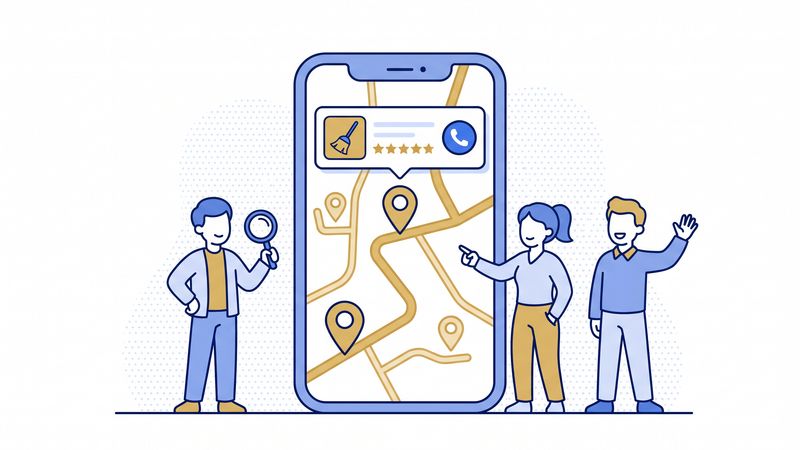
When somebody searches “cleaner near me” or “end of tenancy cleaning [your town]”, the map results at the top of the page take the biggest share of the clicks. Those results come from Google Business Profile, and a free, well-kept profile will outperform a neglected one from a much bigger company.
What a well-kept profile looks like:
- Claimed and verified, with your service area, hours and phone number filled in completely
- At least 15 real photos: your team, your kit, your van, genuine before-and-after shots
- A steady flow of reviews, every one of them answered
- A short update posted weekly (a finished job, a seasonal offer, a new service)
Google’s local ranking rewards activity and proximity, not company size. One UK cleaning company that rebuilt its local pages and filled out its Google profile properly saw bookings from local search nearly triple within six months. Twenty minutes a week is the going rate for this channel. Pay it.
2. Local SEO and AI Search: Be the Answer, Not Just a Listing
Your website needs to rank for the searches people actually type: “domestic cleaner Reading”, “office cleaning prices”, “how much does a deep clean cost”. The recipe has not changed much. A fast site, a separate page for each service and each town you cover, and the place names used naturally in titles and headings. Write like a person who lives there, because you do.
What has changed is where people ask. A growing share of “find me a cleaner” questions now go through AI assistants and Google’s AI Overviews rather than ten blue links. These tools lift their answers from structured, well-organised pages, so:
- Add LocalBusiness schema markup to your homepage and service pages
- Keep your name, address and phone number identical across every directory
- Answer real questions in plain language on your site: what an end of tenancy clean includes, how pricing works, whether you bring your own products
And here is the part most cleaning companies miss: AI assistants cite pages that answer questions directly. I have watched it happen with my own articles, which get quoted by AI tools precisely because each section answers one question cleanly. The same approach works for a cleaning site. If you want the longer version of how that works, I wrote a separate guide to getting cited by AI search.
3. Reviews: The Trust Engine
Nobody hands their house keys to a company with no reviews, no matter how good the website looks. Reviews do more for a cleaning business than any advert, because they answer the only question that matters: do other people trust these strangers in their home?
Getting them is mostly about timing. Ask when the client is happiest, which is usually right after the first clean, when the difference is dramatic. A short message that evening with a direct review link converts far better than a plea buried in an invoice a month later. Print the link on a card. Hand it over in person. Old-fashioned, and it works.
Respond to every review, including the rough ones. A calm, specific reply to a one-star complaint reassures the next hundred readers more than the complaint itself worries them. Silence reads as guilt.
One rule with no exceptions: never buy reviews, and never review-gate (only asking happy customers while steering unhappy ones away from Google). Both breach Google’s policies and the CMA has been actively pursuing fake review practices in the UK.
4. A Referral Programme That Actually Pays
Word of mouth already brings most cleaning businesses their best clients, it just does so slowly and by accident. A referral programme is word of mouth with the handbrake off.
Keep it embarrassingly simple. A two-sided reward works best: the existing client gets a free clean (or £20 off) when their friend completes a first booking, and the friend gets a discount too. Both sides win, and the cleaner who passes the card along looks generous rather than salesy.
The economics stack up because of that recurring revenue maths from earlier. Research published in the Journal of Marketing, co-authored at the Wharton School, tracked nearly 10,000 bank customers and found referred ones were at least 16% more valuable and around 18% less likely to leave. For a cleaning business, where one referred client can mean years of weekly bookings, a free clean as a finder’s fee is the cheapest acquisition you will ever buy. Mention the programme everywhere: on the review card, in your email footer, on the invoice, in a quick word at the end of a clean.
5. Lead Platforms and Directories: Use Them, Don’t Depend on Them
Checkatrade, Bark, Rated People, TrustATrader: every cleaner has wondered whether they are worth it. Here is the honest answer most blogs written by these platforms will not give you. They are a decent way to fill a quiet diary in your first year, and a poor thing to build a business on.
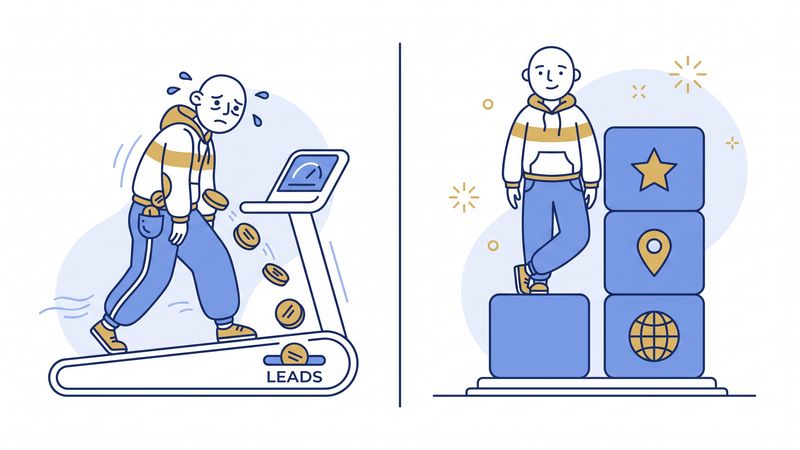
The problem is structural. On pay-per-lead platforms you are usually one of several businesses buying the same enquiry, so you pay whether or not you win the job, and the platform owns the customer relationship. Win the work, do it brilliantly, and the next time that customer needs a cleaner they may well go back to the platform rather than to you. It is a treadmill, you can run on it forever and stay exactly where you started.
So use them with eyes open. Take the leads while you build the assets you own: your Google profile, your reviews, your referral engine, your website. The free, community-shaped channels deserve more of your time than they get. Local Facebook groups and Nextdoor are where “can anyone recommend a cleaner?” gets asked every single day, and a recommendation from a neighbour beats a paid listing every time. Be present, be helpful, never spam.
6. A Website That Quotes Fast
Most people who hire a cleaner start with a quick online search, usually comparing two or three companies in one sitting. The company that makes the next step easiest tends to win, which is unfair on whoever cleans best, but that is how it goes.
Your website needs to do three things within seconds of loading on a phone:
- Say what you clean, where, and roughly what it costs
- Show proof: reviews, photos, insurance, DBS checks if you offer them
- Offer a stupidly easy next step: a quote form with three fields, a WhatsApp button, online booking
Pricing transparency is the bit that feels uncomfortable and works anyway. Publishing “from” prices filters out the bargain hunters before they waste your evening, and signals confidence to everyone else. Hiding prices does not make you look premium, it makes you look like a faff. (If your site is slow on mobile, fix that first; I cover why in my web performance and SEO service page.)
7. Stepping Up to Commercial Contracts
Domestic work builds the business, commercial contracts build the asset. Offices, dental practices, gyms, letting agents and serviced apartments all need cleaning on a schedule, they pay on invoice, and they sign contracts measured in years.
The approach is different from domestic, and slower:
- Target the right size. Offices of roughly 5,000 to 20,000 square feet are the sweet spot: big enough to pay properly, small enough that you talk to the actual decision-maker rather than a procurement department.
- Go direct on LinkedIn. Office managers and facilities coordinators are easy to find there and hard to reach by phone. A short, specific message beats a brochure.
- Always walk the site before you quote. A walk-through stops you underbidding, and asking sharp questions during the visit is itself a sales pitch.
- Look boring on paper. Insurance documents, RAMS, references, a proper service agreement. Commercial clients buy reliability, and paperwork is how reliability looks before you have cleaned anything.
Expect 30 to 90 days from first contact to signed contract, and do not let the wait put you off. Last month I sat with a small business owner who had spent £300 a month on shared leads for a year; one landed office contract, won through a free walk-through and a tidy proposal, was worth more than everything that spend had returned.

Measuring What Actually Works
You do not need a dashboard, you need a sheet of paper and a weekly habit. Track:
- Google Business Profile actions: calls, website clicks, direction requests
- Enquiry source: ask every new enquiry “how did you find us?” and write it down
- Quote-to-client conversion: how many quotes turn into recurring bookings
- Client retention: how many of January’s clients are still with you in June
- Review count and rating: the leading indicator for everything else
After 60 days, double down on whichever channel brings clients who stay, and quietly drop whatever brings one-off bargain hunters. Most small cleaning companies spread themselves across six channels badly instead of doing three well.
Summary: How to Get Clients for a Cleaning Business in 2026
Start with the channels you own. A complete Google Business Profile, a steady review habit and a simple referral programme cost nothing but consistency, and they compound. Add a website that quotes fast and answers questions plainly enough for AI search to quote you. Use lead platforms as scaffolding while you build, not as the building. And when the domestic side runs steady, go after commercial contracts with a walk-through and proper paperwork, because that is where a cleaning round becomes a sellable business.
None of this is clever. It is a short list of unglamorous things done every week, which is precisely why so few of your 79,000 competitors do them. That is your gap.
Want a second pair of eyes on your cleaning company’s marketing? Book a free 30-minute Growth Audit and I’ll show you exactly where your biggest opportunities are.